Saturday, May 9, 2015

Nanjangud Nanjundeswara

Sri Srikanteswara/Nanjundeswara Temple at Nanjangud is one of the sacred shrines of Karnataka state. It is 25 km away from Mysore on Ooty road that goes through Bandipur Wildlife sanctuary. It is well connected by buses from Mysore that ply frequently.

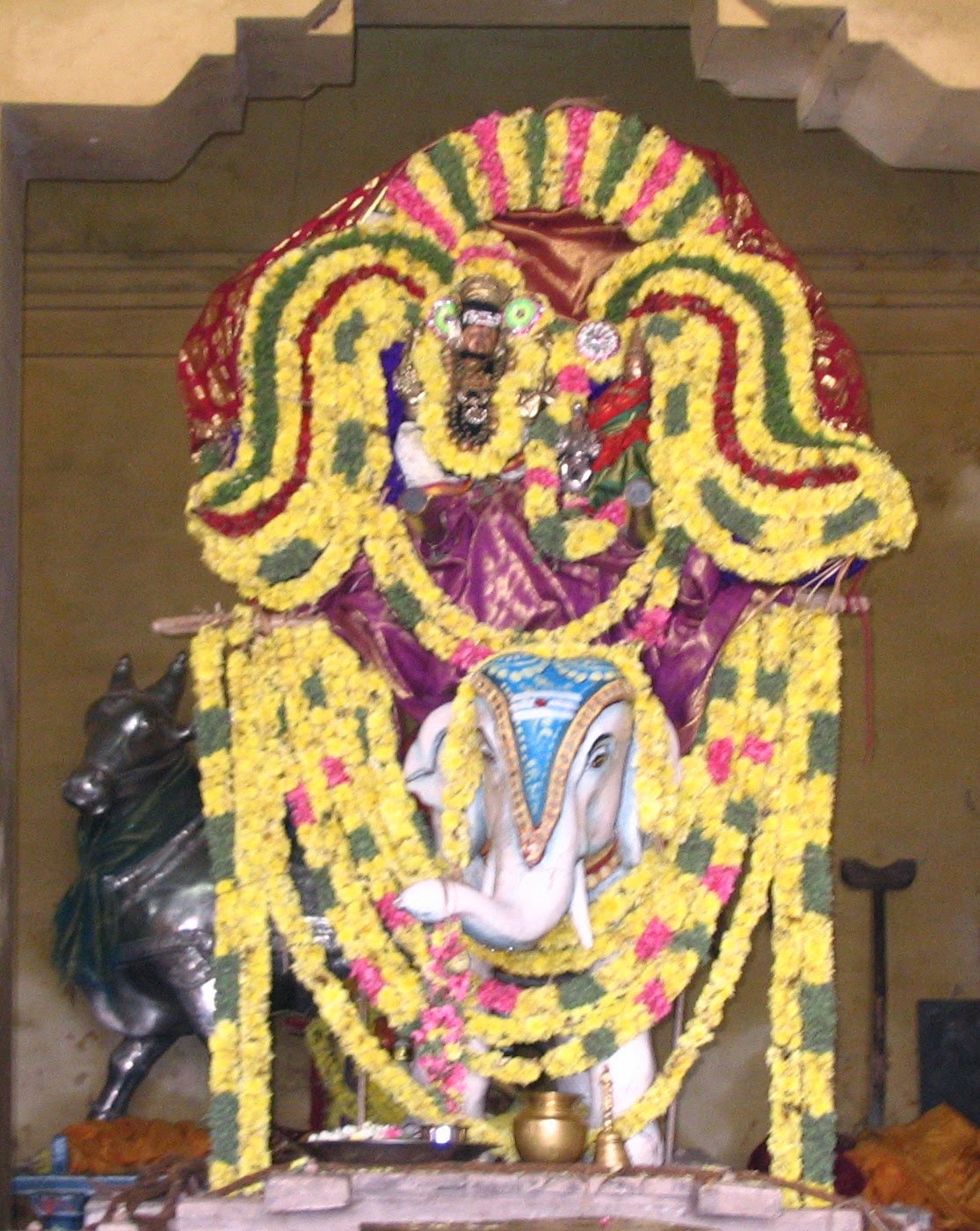
Gaja Samhara Murthi
This Temple is on the banks of the river Kapila/ Kabini which is considered as sacred as Ganga. Hence the town is regarded on par with Kasi to be known as Dhakshina Kasi. Similarly we have Dhakshina Kasis in Tamilnadu at Vridhachalam and Srivanchiyam(Where the river,Manimuthar  and the Temple Tank,Guptha Gangai respectively are considered as River Ganga)

When the Devas and Asuras churned the milky ocean, Halahala,the deadly poison which could ruin the entire Universe came out. The frightened Devas took asylum at Kailash and prayed Lord Shiva to protect them. The Lord consumed the poison and it stayed at His neck, hence the name Neelakanta  He is worshipped as a remover of all diseases who also liberates the devotees from rebirth. Therefore He is known as '" Bhava roga Vaidyanatha'". The YajurVeda calls Him as The Supreme Physician in Sri Rudram (" Prathamo dhaivyo Bhishak") Gowthama Rishi and Parasurama have worshipped Lord Neelakanta here and were blessed. Parasurama performed "Thapas'' to get himself freed from the sin of beheading his mother Renuka Devi as per the instruction of his father, Jamadhagni Rishi.

This Temple is perhaps one of the largest shrines of karnataka as it measures about 50000 sq.feet . A beautiful 7 tier Gopuram is at the entrance with the outer walls of about 12 feet high. The outer wall presents a row of carefully carved images. 32 forms of Ganapathi are also seen in the Temple as described in the Puranas.

 Emperors of Chola,Hoysyala and Vijayanagara had constructed different parts of the Temple during their regime. The Shrine enjoyed a special status under the rule of Mysore King, Krishna Raja Wodeyar .A big Nandi is at the front Mandapam.

The inner Prakaram offers a gallery of 63 Nayanmars and the different forms of Lord Shiva, Kiratharjuna Murthi, Chandikeswara Anugraha Murthi,Kiratha Murthi,SankaraNarayana Murthi,GirijaKalyana Murthi,  Nataraja Murthi to name a few.

Apart from the daily Pujas, the Temple attracts thousands of pilgrims during Maha Shivarathri in Februay/March, Girija Kalyana in July, Chikka Jathra ( Three exquisitely carved wooden chariots drawn by devotees) in November and Pancha Maharathothsava in April. 

Monday, May 4, 2015

Gokarna, The Dhakshin Kasi

According to the Legend, even a glimpse of Gokarna , one of the holiest shrines of Lord Shiva ,  bestows immense blessings to the Devotees. It is considered as Dhakshina Kasi, as Holy as Varanasi and the Temple Tank, Koti Theertham ,as Holy as River Ganga.

Gokarna is located in the Uthara Kannada district of Karnataka state. It is on the Karvar coast of Arabian Sea.It is about 60 Km from Karvar, 250 Km from Mangalore,160 km from Hubli and 450 km from Bangalore. This Temple town is close to Mangalore- Mumbai National Highway. Pilgrims fom Chennai can take the direct train to Hubli and then go to Gokarna by bus which takes around 4 hours. There are many choultries , Lodges and resorts in this town to suit various segments of pilgrims. Many foreigners visit this town as it is hardly 150 km from Goa, the Tourist destination. The nearest railway station, Gokarna Road is 6 km away from the town.The ocean with the roaring waves coupled with the sand bed and Camel rides attract them. The town,  overlooking both the Western Ghats and the Ocean presents a breathtaking picture to the visitors.

 The long journey by bus from Hubli can be less cumbersome by breaking it in the middle. We broke the journey at a choultry where the pilgrims were offered breakfast. Karnataka is known for its hospitality as most of the famous Temples feed the pilgrims twice everyday.

The Legend of this place traces back to the Ramayana period when the Demon King Ravana went to Mount Kailash and performed severe penance. His aim was to get back the Atmalinga stolen from him and thrown into the sea by Devendra. It was originally worshipped by Ravana' s mother for the prosperity of her son. Angered by the act of Indra, Ravana promised his mother that he would get back the Atmalinga from none other than Lord Shiva Himself. He praised the Lord with Shiva Thandava Sthothram and started offering his organs into the Homa Kundam. The Lord appeared in font of him and gave the Atma Linga to him and bestowed many boons with the condition that the Atma Lingam should not be placed anywhere in the middle until his return to Lanka.

On his way back Home, Ravana, on reaching the shores of Gokarna wanted to perform his evening prayers ( Sandhya Vandhanam ). There appeared Lord Ganesha in the form of a brahmin boy. Ravana requested Ganapathi to hold the Atma Linga in His hands until he came back after finishing the prayers. Ganapathi accepted his request with one condition that He would call Ravana by his name thrice and it was upto him to collect the Lingam before that  time. Otherwise he would place the Lingam on the ground.

Ravana could not return before the specified time and Ganesha called Ravana thrice quickly and placed the Lingam on the ground . Ravana chased the boy and gave a blow on His head. Lord Ganesha vanished from the scene and Ravana tried his best to lift the Atma Lingam but in vain. The Linga Murthi was deeply rooted by that time and Ravana could only feel the top of the Lingam and felt it as the ear of the Cow. Hence He named Him as Go karneshwara and Mahabaleshwara.
The west facing Temple was constructed during the period of    Mayuravarman ( 345- 365 CE) The Vimanam above the Sanctum is in Dravidian style. There is a prakaram aound the sanctum and a separate shrine for Goddess Parvathi ( Thambra Gowri). The Temple was visited by Vijayanagar Kings and Chatrapati Shivaji.

Koti Theertham
 The devotees take bath in the ocean and then in the Temple Tank, Koti Theertham and worship Sidhi Ganapathi at the Temple close to Gokarneshwara' s Shrine.Ganesa Muthi of this type is unique with two hands and in standing posture. Then they proceed to Gokarneswara Shrine where Pujas are held thrice in a day. The pilgrims are allowed to touch the Lingam inside the square pedastal and offer abhishekam.

As the place is regarded as pious as Kasi, devotees pay their respects to their ancestors by performing '" Pithru Karmas'" on the banks of Koti Theertham.

Maha Shivarathri festival in Feb-March draws very large number of devotees . The Chariot festival is held with the images of Shiva and Parvathi kept on the decorated wooden chariot.People pull the chariot with lot of enthusiasm accompanied with drum music.

The Main deity of the Temple is sung in Thevaram Hymns that date back to 6-7th century. Tamil Saint Gnanasambandhar sang a ' Padhigam'  for this place during his visit to Kalahasthi. It was Saint Appar (Thirunavukkarasar) who walked all the way to Gokarna and sang a Padhikam in praise of Lord Gokarna. He made reference to the sea shore on which the Temple stood. The Temple authorities should include this Historic incident in their publications and inscribe the Hymns on the wall of the Temple to preserve the ancient History related to it.

Among the Pancha Linga kshethrams of this region, the other four Temples are at Dhareshvar, Gunavantheshwar, Mrudeshwar and Shedjeshwar. 

Monday, April 6, 2015

Sarabeswara Sannadhis

Fear is the key at various stages of life. It may be due to illness, enmity or anything that can cause worry to the mind. Many of us stand clueless once our attempts become unsuccessful. The agony caused is too much for anyone to bear. Mythology shows the way to come out of such a challenging situation. It tells us how God is merciful if we seek asylum in Him. Yes, it is our good fortune which alone can direct us in that direction.

When Lord Vishnu came out of a Pillar to show he was present everywhere, it was not just to destroy the Demon King Hianyaksha but also to bless His devotee, Prahaladha. He did not control His anger even after killing the Demon. Devas feared that the killing spree would continue. Then they went to Kailash and reported the matter to Lord Shiva and prayed Him to save the World from the fear of destruction. The Lord took the form of Sarabha Pakshi, as a combination of Lion and a bird with large wings and held Narasimha in His hands On seeing Lord Shiva appeared before Him, Vishnu with folded hands pleaded mercy for His act What we see in sculptures pertaining to Sarabeswara depicts the very moment in which Shiva controlled the angry Narasimha to remove the fear of Devas and others.

There are many shrines where Sarabeswara sannadhi is prominent. We can name a few of them which are housed in Temples where the main shrine is that of Shiva Linga Murthi. In general, the Sarabeswara sannadhi faces south. As South is the direction meant for Yama, The Lord faces that direction and protects His devotees from the clutches of Yama.

Abath Sahayeswara Temple at Dugachi,near Nachiar Koil has a small sannadhi for Sarabeswara. The idol faces south and attracts devotees and the Temple is undergoing renovation though at a very slow pace. This Temple was built by Vikrama Chola.

The biggest sannadhi for Sarabeswara is at Thirubhuvanam, about 7 km east of Kumbakonam. The Sanctum is located at at a height similar to the Temples at Thanjavur, Gangaikonda Cholapuram & Darasuram where the Vimanam above the sanctum is higher than that of the Raja Gopuram. Since the Lord removed the fear of Devas , He is known as Kambahareswara. The Chola Temple has a south facing sannadhi for Sarabeswara where people from different places come to worship Him with the prayer to remove the obstacles faced in their lives. It attracts good crowd on Sundays during Rahukala ( 4.30 – 6.00 p.m) when special pujas are performed to Sarabeswara.

People are generally not aware of an important Temple related to Sarabeswara at Narasingan pettai which is near Aduthurai on Kumbakonam – Mayiladuthurai road. The Temple is located about 1 km off the main road. The legend says that Narasimha , after realising His mistake worshipped Shiva here. The Temple , not very big though, has a beautiful vimanam above the Sanctum. The Linga Murthi is big and one can see the sculpture showing Narasimha’s worship of Lord Shiva.


It is interesting to see the Sculpture of Sarabeswara in the Pillars of various Temples. The one at Koyambedu, Chennai attracts hundreds of devotees on Sunday evenings. But the strange aspect is that we find Sarabeswara with two heads, holding Narasimha in His hands. It is not clear why He is shown with two heads. This sculpture is in a Temple at Thirisoolam, on the out skirts of Chennai.              

Monday, February 9, 2015

Pradosham at Erukathampuliyur

We come across many places which are named after an event or person. We also find the names related to trees which are considered as sacred to that place. Vanniyoor is named after the sthala vruksham of the place,namely, Vanni.Thillai tree is related to Chidambaram. Thirumullaivaayil gets the name after the shrub called "Mullai ". Similarly, the plant ,"Erukku " , being the sthala vruksham , forms the first part of the name of a place and the second part is atributed to a Rishi known as Vyagra patha. Both put together, the place is called as "Ërukkaththam puliyoor." It is now called as Rajendira Pattinam. It is located 12 km south of Vruthachalam on Jayamkodam road. The east facing Temple is sung by Thirugnana sambandhar in the 7th century.

The Temple has two prakarams. It has got 40 ft high Raja gopuram. Vel eruku is the sthala vruksham which can be seen in the prakaram.Sidhi ganapathi, Nardhan ganapathi, Subramanya are the Murthis we worship in the Prakaram. When Shiva was explaining the meaning of Vedas, Parvathi did not show rapt attention to it. Angered Shiva cursed her to take birth in fisher man''s community. On seeing this, Subramanya threw the Vedic manuscripts into the sea. It made Shiva to curse Subramanya to take birth as a dumb Subramanya, as dumb, named as Rudra sarma worshipped and got rid of his dumbness. Rudrasarma's figure is also seen in this Temple. When Devaganas prayed Vruthachaleswara to tell a place which could easily grant salvation, The Lord asked them to go to Erukathampuliyur. Hence the place is also known as Ganeswaram.

Erukku- Sthala Vruksham
When a hunter saved a brahmin from a Tiger,he was blessed to take birth as Vyagrapatha and worship Shiva. Therefore the place is called as Puliyur. The legend also says that a King of Madhurapuri visited the Temple and prayed. His prayer was answered and he was blessed with a child.He named his son as Rajendran and the place got the name, Rajendrapattinam.Naimicharanya rishis took the form of the plant "Ërukku"  and worshipped the Lord. It is for this reason the place is known as "Erukkathampuliyur" This is also a place which removed the disease of a King from Ujjain. Arunagirinatha has sung Thirupugazh in praise of Subramanya of this Temple.Sivaprakasa has authored the Sthala Puranam of this Temple.


Erukkaththampuliyoor is also the birth place of  Thiruneeelakanda Yaazhpaanar, one of the sixtythree Nayanmaars. Being a great player of the instrument "Yaazh" , he accompanied Thirugnana Sambandhar wherever the Acharya went. His wife , Madanga Choolamani also joined him in this Pilgrimage to several Shiva Shrines. They entered "Siva Jothi " at Nalloor Perumanam ,now known as Achalpuram along with hundreds of devotees. The girl of  Yaazhpanar's legacy, set tunes to Thevaram Hymns. The idols of  Yaazh panar's family are installed along with those of the four Saiva acharyas in the prakaram.

In contrast with crowded Temples of major Towns on Pradosham days, Erukathampuliyur presents a serene look on this day. The Nandi Mandapam, located between the Rajagopuram and the Temple Tank makes the atmosphere more Divine. Not many people join the occasion except some visitors from outside and very few persons of the village.

However, the Pujas started with Abhishekam to Lord Neelakandeswara followed by Deeparadhana. Abhishekam is then performed to the Nandi with Milk,curd, Honey, Vibhoothi, Coconut water ,vibhuthi and sandal paste. If anyone want to visit a Shiva Temple on Pradosham where one can have dharshan easily, this is one of those places free from crowds.

The Temple is undergoing renovation and lot of work remains to be done. The work has to be speeded up with the support of Philanthropists to perform the consecration at an early date.    

Sunday, January 18, 2015

Siva Temples near River Arasalar

It is always a breath taking journey if we drive along the banks of a river when it is in full flow. The atmosphere becomes rich when we see green paddy fields all around and the adjoining groves that present a beautiful sight. It is true with tributaries of a major river like Cauvery in  south India. Normally the Siva Temples of Chola Kingdom are geographically identified by describing them as being north or south of the river. Umapathy Sivam,one of the Santhanacharyas who has authored eight books on Saiva Sidhantha , in his work called "Siva Kshetra Siva nama KaliVenba" gives the names of the Main deities of the Temples , sung in Thevaram Hymns which are located on both sides of the river.

 December to March are the ideal months to enjoy the beauty of the nature when farmers are busy with their harvest operations. The tributaries seem to be less polluted than the parent river as they rarely pass through major towns. A drive along the river Arasalar proved this point and takes us to various shrines of Lord Shiva located close to her banks. It is always difficult to cover the entire route of the river in a single trip as we are engaged in visiting the temples in parallel. Hence we divide the route according to our convenience and try to visit as many temples as possible in a trip.

We selected the middle portion of Arasalar this time and tried to cover temples on her southern banks. Kumbakonam can be the base from where the journey  be started. The first leg of the tour starts from Saakottai which is 5 km from Kumbakonam. The road divides into two at this place, one going towards Thiruvarur and the other one to Mannargudi.


We reach Kalayanallur which should be less than a km from Saakottai on Mannargudi road. This Temple is sung by Sundara Murthi Nayanar and the main deity is called Amrutha Gatehsvarar. A calm place though, the place is so serene that offers lot of peace to the visitors. Sundarar's Padhigam on the Lord is so beautiful that it narrates Shiva Parakramam in each Hymn.

Sivapuram is located 3 km away from Saakottai. It is also sung in Thevaram by Sambandar and Appar. The Main deity, Sivagurunatha was worshipped by Vishnu in the form of white pig. The shrines of Goddess Aryambha and Bhairava face south. The Rajagopuram in the front is imposing.

By driving on Thiruvarur road for about 5 km, we reach Arisil karai Puthur ,surrounded by paddy fields. Arasalar was called Arisil in Chola times. Thevaram differentiates clearly the exact locations of places having the same name. Puthur near Valangaiman which is on the banks of the river Kaduvai is called Kaduvaaikarai Puthur. The one near Sivagangai is called Thirupputhur. Similarly, Puthur near Saakottai is called Arisil Karai Puthur as it stands near the river Arisil . This Shine is sung by all the three acharyas in Thevaram. The Hymns also describe the sincerity of the then Temple priest, Pugazhththunaiyar, when severe drought struck the village that made everybody to desert the place. However the Priest determined to stay back and continue his service despite being hungry for days together. The Lord rewarded Pugazh thunai Nayanar a coin a day to drive away his poverty . The images of the Nayanar  and his wife are seen in the Mahamandapam of the west facing Temple.

Another 3 km drive along the same route takes us to Naraiyur( to be pronounced as நறையூà®°் and the one on Chidambaram - Kaattumannargudi road is pronounced as நாà®°ையூà®°் ) which is on the outskirts of Naachiyar Koil. Sidheswara Swami Temple of Narayur also faces west. Sung by Sambandhar and Sundharar, this Temple belongs to Chola  period.

As we follow the river Arasalar, we need to take a diversion near Naachiarkoil bazaar and drive on Poonthottam road. Penuperundurai , sung by Sambandar is now called as Thiruppanthurai.  The Temple Tank is seen right in front of the main entrance. Two Ganapathis are seen in a small shrine near the entrance. As we enter the Temple, we come across Nandi,Bali peetam and then south facing Ambal Sannadhi. Mangalambikai, The Goddess presents a graceful look. The Moolavar in the Sanctum is known as Sivanandheswarar. As He is worshipped by Bala Subramanya, we notice the image of Subramanya  holding "dhandam" near the entrance of Swami Sannadhi, facing north.

Brahan nayaki Sametha Abathsahayeswara Temple of Vikrama Chola's period comes next at a village called Dukkachi named after Goddess Durga who  worshipped Lord Siva here. A completely ruined Temple is being renovated  but at a slow pace. This shrine is known for its beautiful  carvings ,most of them are vandalised. It remains to be seen how best the renovation is done without altering the original structure along with the inscriptions.

Romacha Rishi had worshipped Jambukaranyeswara at Koondhalur which is located on the same road. The Temple,Tank and the garden are maintained well. Saint Arunagirinatha has sung Thirupugazh on  Lord Subramanya of this place. Both Ganapathi and Subramanya shrines are seen in the front as against the usual places on the backside of the Sanctum. Goddess Anandhavalli faces south and it gives a great feeling when we have dharshan of Lord Subramanya,  seated on a peacock
.
Koondhalur and Pudhukkudi are Thevara vaippu sthalams in this route. Before proceeding to Pudhukkudi, we pay a visit to Karuvili, a great shrine about 1 km from the main road. Sathguneswarara of Karuvili is sung by Saiva Saint Appar. Goddess Sarvangasundhari  is tall and known to fulfil the desires of the devotees.devotees. Yama theertham is facing Temple.

Swetharanyeswara  Temple at Pudhukkudi, a  Thevara Vaippu sthalam wears a new look after the recent consecration. Though a small Temple, it should be admied for  good maintenance. The painter deserves commendations as the painting near the sudhai of Dhakshinamurthi is  nice to watch.

Sthalapuranam of Manavalanallur is linked to that of Thiruveezhimizhalai where Parvathi,as Kathyayani married Nethrarpaneswara also known as Veezhinatha.  This  is also a small temple with not many visitors from outside the village.

Thethiyur, once the home of great Pundits still carries the old memories. Meenakshi Sundareswara Temple  is on the middle of the village. As the priest was not available, the temple was seen locked. We were told about the Temples at Vishnupuram.  As it was already past noon, we wanted to avoid disappointment and postponed the visit to these places to a later date.


Thursday, December 4, 2014

Temples at tail end of River Cauvery

The northern bank of the river Cauvery from Kallanai to Poompuhar has many Temples that are rarely visited. Even the tail end areas of Cauvery are blessed with green paddy fields and  other high yielding crops. The final part of the river carries green memories for the visitors  who look for such an atmosphere.

The journey from Mayiladuthurai to Poompuhar on the northern bank of the river covers a distance of about 25 km. The first leg of the visit on Mayiladuthurai- Poompuhar road starts with an unique "dharshan" of Medha Dhakshinamurthi at Sri Vadhanyeswara Swami Temple on the northern outskirts of Mayiladuthurai, close to Seerkazhi road. This part of the town is called as "Uththara Mayuram"in the Puranam.


When the Holy Bull thought with an ego that it was carrying the Lord, it was asked to do penance on the northern bank of Cauvery, Shiva appeared in front of the Bull along with Ganga Devi and blessed it on an Amavasya day in the Tamil month of Aipasi and blessed. Hence the Ghat here is called, Rishabha Ghat and usually called as Thula Ghattam. During the festive month of Thulam ( Aipasi), The Lord , Medha Dhakshinamurthi, seated on silver "kailasa Vahanam", followed by Ganga  Devi on Crocodile Vahanam gives Dharshan to all devotees every year. People take bath in Cauvery during this unique event.

 On the last day of the month, The Lord ,in the form of Somaskandha Murthi, flanked by Gnanambikai , Ganapathi, Subramanya and Chandikeswara give "Theerthavari" in the river. The Temple of Vadhanyeswarara ,usually called as "Vallalar Koil"faces west and on the Deva Ghoshta, we have dharshan of Sri Medha Dhakshinamurthi with Nandhi in font of Him. The sannadhi draws good crowd on Thursdays and in the Tamil month of "Karthigai" when Mahabhishekam is conducted for Medha Dhakshinamurthi.

When we proceed towards Poompuhar we find many villages close to the main road, each one of them having a historic Temple. The Temples of Pasupatheeswara at Pasupathi Agraharam and the one at Karum Kuyil Nathan Pettai are about 3 km from Mayiladuthurai. On the outskirts of Manakkudi, we find a temple,renovated in the recent past,situated very close to the road. Though small in size, the Temple dedicated to Sri Sivakamasundhari sametha Sri Chidambareswarar presents a  serene atmosphere with a good garden having many species of plants. Sri Sundhareswarar  Temple is another one to be visited in Manakkudi.

Proceeding  further for about 4 km, we arrive at a village called "Kanja Nagaram", a big village having Temples dedicated to Vishnu, Mariamman and Subramanya besides an imposing Temple for Lord Shiva. Though the Raja Gopuram is not there, the Temple is located in a sprawling site of the village. Both the Goddess Sri Thungabala Sthanambika and Sri Garthra Sundhareswara are tall deities , occupying separate sannadhis. Swami sanadhi, facing west has a big vimanam above the sanctum.


This village is associated with Manakkanjara Nayanar, one among the 63 Nayanars praised by Sri Sundhara Murthi Nayanar in his Thevaram Hymn.Therefore the village  was named after him as Kanja nagaram. We can see the deities of Manakkanjara Nayanar, his wife( called Kalyana Sundhari ), his daughter (called as Punya Vardhini) along with her husband, Eyarkon Kalikkaama Nayanar, another Nayanar,celebrated by Sundharar. The story of how Lord Shiva blessed both Manakkanjarar and his family is given in detail by Sekkizhar in his outstanding work, Periapuranam.  The same story is narrated at another place known as Anandha Thangdavapuram ( called as Kanjaru in Puranam) , some 5 km northwest of Mayiladuthurai. Panchavateeswarar Temple of this place is also having deities of Manakkanjarar and his family.Consecration is being planned for Gartha Sundhareswarar Temple in the coming year.

When we take a round of the sannadhis, we notice steps taking us to Sattanatha swami sannadhi on top. A dancing Ganapathi gives dharshan at the beginning of the foot steps.

The Subramanya Temple of Kanja nagaram is not far away from Gathra Sundhareswara Temple. Sri  Subramanya, seated on a peacock, flanked by Valli and Deivaanai occupies the sanctum. A Shiva Lingam in Mahamandapam  called "Paapa hareswarar " and Kasi Visvanatha in the outer Prakaram are important Siva sannadhis of this Temple. The shrine carries a newlook as it was renovated and consecrated quite recently.

On travelling further, we reach Karuvazhakarai , a famous pilgrim centre dedicated to the Goddess Mariamman,now called as Kamakshi. On the outskirts of this village starts another village called Marudur. One has to visit Sri Raja Rajeswara Swami Temple of this place to believe how best a good garden with so many species can be maintained well in the Temple complex. Name any tree or flower dedicated to Lord Shiva, we can see them here all due to the tireless effort of the Sivacharyar who deserves praise from one and all. The Temple was consecrated during last year but still awaits people in good numbers which alone can bring development . The locals should also support it so that it will boost the enthusiasm exhibited by the Sivacharyar.He can be contacted on 09597437157 to give prior intimation of your visit.

Vennai Eswaran Koil and Swayambunatha Swami Temple are at Melapathi , another village close by. The other Temples located at Manigramam, Thiruvenkadu, Keezha Peumpallam, Melap Peumpallam, Thalaich Sangadu, Chayavanam, Pallavaneeswaram ,Kadaimudi(Keezhaiyur)are not to be missed before reaching Poompuhar where the river Cauvery  enters  the sea.

Saturday, September 27, 2014

Vedharanyam Temples

Before worshipping Lord Shiva at Vedaranyam, the four Vedas stayed at a place called Chathurvedapathi now known as Nalu Veda pathi, and collected flowers and garlands from a place called Pushpavanam for doing the Puja. Veda vanam also known as Vedaranyam attained the name because of the worship made here by the Vedas. As the main door was kept closed, people used to enter the sannadhi through the entrance at the side. It was only when the Saiva Saints Thirugnanasambandhar and Appar visited the place and sang Hymns in praise of the Lord, the Main doors opened and closed for regular worship for all.

Vedaranyam is located 45 km from Nagapattinam; 35 km from Thiruthuraipoondi;63 km from Thiruvarur; about 100 km from Kumbakonam. The nearest airport is Tiruchirappalli which is about 135 km away. Although bus services are available to reach Vedaranyam ,it is better to go by car if one has to visit the nearby places like Agasthiyanpalli, Ramar Patham,Kodikkarai,Pushpavanam and Naluvedapathi.

There stands a 5 tier Rajagopuram at the entrance of Vedaranyeswarar Temple which faces east. The sea is around 1 km east of the Temple. At the sannadhi street corner, we see the dilapidated wooden chariot left uncared. It is said that the Temple management is arranging to get a new wooden car in the near future.

Ganapathi sannadhi at the westen Tower has a legend behind it. Lord Rama,caught by "Veea Hathi", a sin caused by killing a demon , worshipped Ganesa here and the Lord kiked the "Hathi" with His leg and Rama was freed from the sin. Hence Ganesa of this sannadhi is called "Veera Hathi Chetha Ganapathi".

The outer Prakaram consists of an exclusive shrine for the Goddess, known as Veda Nayaki. She is also called as Veena vaadha Vidhooshini in Sanskrit and Yaazhaip Pazhiththa Mozhiyaal in Tamil. This Sannadhi,one of the Shakthi Peetams, with a small Gopuram is to the left of Swami Sannadhi.

As we enter the Eastern Prakaram, we find the Temple Tank, Manikarnika, which is as Holy as Ganga,Yamuna.Cauvery,Narmadha and Sindhu. People take bath in large numbers during New Moon days and auspicious occasions like Mahalayam , Lunar and Solar eclipses. There is a small shrine for Kala Bhairava facing the Tank.

The next Prakaram has sannadhis for Saint Sundharar facing Thyagaraja , sixtythree Nayanmars, "Kaakshi Koduthavar" , Sthala Ganapathi, Subramanya,Gajalakshmi, Saraswathi Devi (in huge form), Gajalakshmi and Southfacing Durga Devi. Navagrahas are looking at the same direction. It is said they curiously look at the Newly wedded Divine Couple of Parvathi and Parameswara. The four Saiva Acharyas look at the Supreme Dance of Lord Shiva.

 The sanctum is on a slightly elevated platform. The Divine couple who gave dharshan to Saint Agasthya can be seen behind the swayambu Lingam , Sri Vedaranyeswarar.  When all Devas ,Rishis and others attended the Marriage of Parvathi- Parameswara at Kailash, the Mountain tilted down and it was at that time Lord Shiva asked Sage Agasthya to go to south to balance the earth. Agasthya went to south and the eath returned to normal. As the sage had missed to witness the Divine wedding , The Lord showed it to the Rishi at Vedaranyam.

Vedaranyam is one of the saptha vidanga sthalams and the Vidanga Pooja is held twice in a day. Vanni, the sthala vruksham is seen in the Prakaram. The fruits of the tree are long with thorns on only one side . 29 day Masi Magam festival in May-June is conducted every year when the Deities visit the sea shore on Masi Magam day for "Theerthavari". The sea at this point is called "Veda Nadhi/ Veda Theertham". Vedaranyeswarar is praised in Thevaram Hymns by all the three acharyas. Thirugnanasambandhar sang "Kolaru Padhigam"here before going to Pandya Kingdom at the invitaion of Pandya Queen Mangayarkarasi.

Agasthya was performing Siva Pooja at a place near Vedaranyam and it got the name after the Rishi as Agasthianpalli. It is on the way to Kodikarai ,about 2 km from Vedaranyam. Sambandhar has sung a Padhigam on the Main Deity of the Temple. Agasthya did penace here to have dharshan of the wedded couple. Agni Pushkarani is in front of the temple. Ambikai (Bagam Piriyaal)faces south. There is a separate shrine for Sage Agasthya. Agasthya theertham is on the western side . Vanni is the sthala vruksham of this temple which is seen in the prakaram. Chola and Pandya inscriptions and found in the Temple. Naattukottai Nagarathars have renovated the Temple.

Kodi Kuzhagar Temple at Kodikarai is close to the main road. As it is surrounded by the forest area,not many houses are seen around this area. Saivaite Saint Sundharar refers to the loneliness of this place in his Thevaram padhigam sung on the Lord. The Temple has a Rajagopuram in the front and one prakaram around the sanctum. Anjanakshi sametha Amruthakateswara (Kodi Kuzhagar) temple of Kodikaai has a Subramanya shrine in the prakaram where the Lord holds Amrutha kalasa in one of His hands. Saint Arunagirinatha has sung Thirupugazh in praise of this moorthi.

Madhurabhashani sametha Sugantha vaneswara Swami Temple at Pushpavanam is a temple not to be missed by devotees who visit Vedaranyam. It is located on the way to Nagapattinam . The temple at Pushpavanam is well maintained as the Temple priest who resides nearby takes active paricipation in developing it. The Nandhavanam in the Prakaram aims to justify the name of the place and the name of The Lord as well. There are plans to develop the Nandhavanam further to house more flowering plants.